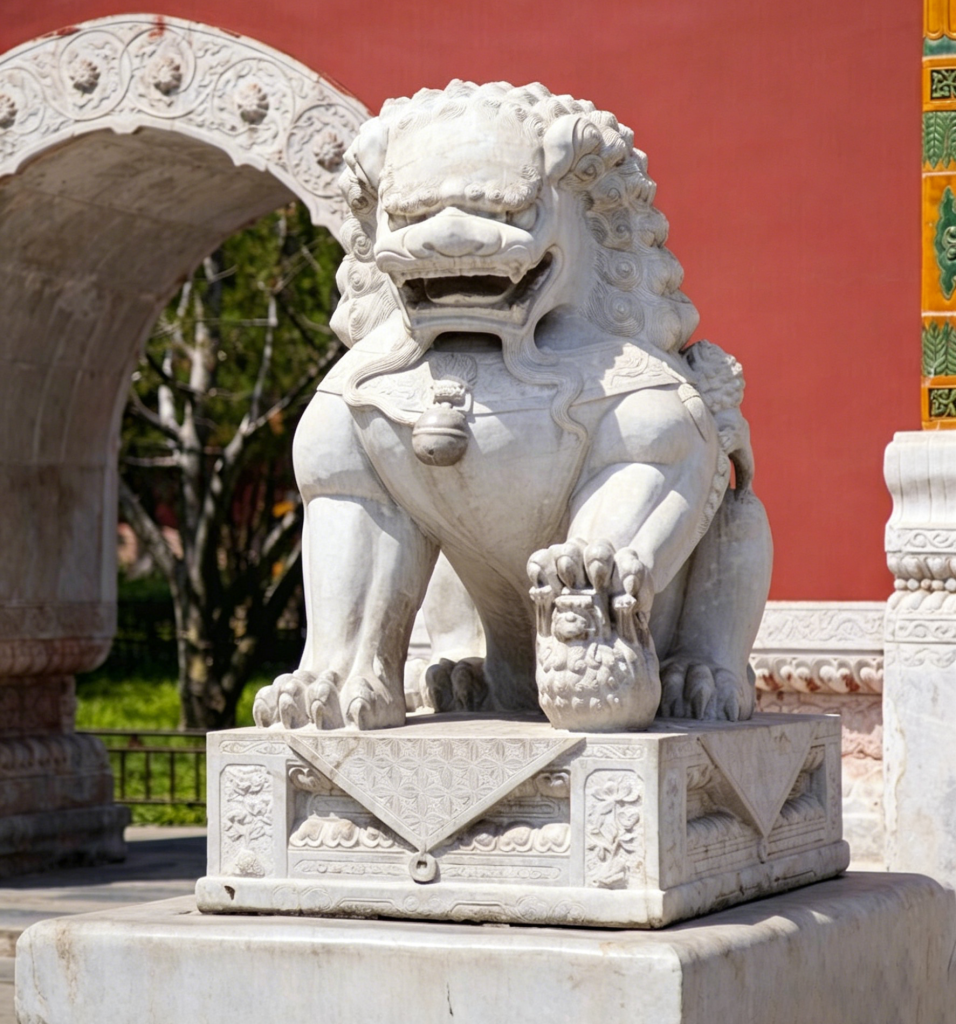
In the contemporary history of Quyang, there emerged outstanding heroes and heroines as well as many masters of arts and crafts, including Peng Guisheng, an early member of the Communist Party of China who once assisted Li Dazhao with the daily work of the Northern Regional Executive Committee of the CPC, Li Dianbing, a national militia combat hero, and Ge Zhenlin, one of the Five Heroes on Langya Mountain. Like shining stars, they adorn the long river of Quyang’s history.Quyang’s sculpture industry boasts a history of more than 2,000 years. As early as the Han Dynasty, it was praised as the "Hometown of Sculpture" by Emperor Wu of Han. Stone sculptures from the Northern Wei Dynasty, such as stone tigers, stone lions and human figures, are simple and vigorous. Birds, stone lions and stone goats from the Wei, Jin and Northern & Southern Dynasties are vividly portrayed. Figures and Buddha statues of the prosperous Tang Dynasty are well-proportioned in structure and dignified in manner. Sculptures of the Yuan Dynasty feature elegant shapes and exquisite workmanship. Yang Qiong, Wang Dao and Wang Hao were representative outstanding artisans of that era. The "One Lion and One Tripod" carved by Yang Qiong was hailed as a masterpiece by Kublai Khan, Emperor Shizu of the Yuan Dynasty.Stone carvings from the Ming and Qing dynasties feature clear lines and delicate craftsmanship. Works such as "Red-crowned Cranes" and "Wintersweet" carved by Quyang artisans in the late Qing Dynasty won the second prize at the Panama International Art Exposition, earning Quyang the great reputation of "Quyang Stone Carvings Are Praised All Over the World".
Since the founding of the People's Republic of China, the ancient art of sculpture has taken on a new radiance. Artisans integrate techniques of relief carving, openwork carving and round carving with modern anatomy, perspective and aesthetics into their craftsmanship. As a result, antique-style works are simple, elegant and lifelike, while modern works are fresh, natural and imbued with profound artistic conception.Lu Jinqiao, a representative master and contemporary national master of arts and crafts, created eight masterpieces including Reclining Guanyin and Three Beauties, which are regarded as national treasures and collected in the China Arts and Crafts Gallery.Zhen Yancang, an international master of arts and crafts, pioneered a brand-new "Western-style" sculpting technique, making his works vivid in both spirit and form. An Rongjie, a first-class master of arts and crafts, carved the camphor-wood statues of the Two Heavenly Kings for Japan, which were hailed as "national treasures handed down through generations" in Japan.Today, Quyang boasts a complete range of sculptures including stone carving, wood carving, ivory carving and bronze carving, with exquisite works of animals, human figures and Buddhist statues each with their own unique charm. The reputation of the "Hometown of Sculpture" has spread far and wide.